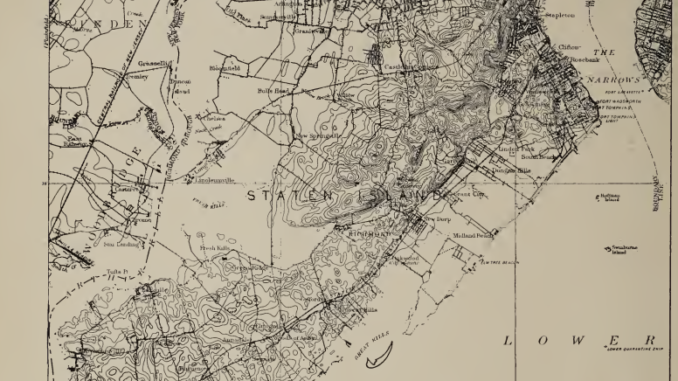
One of the most informative books to be written about Staten Island’s early history is Staten Island and Its People, published in 1930 by Charles W. Leng and William T. Davis. They took 4 years to research and write it. It consists of two volumes — the first one is over 700 pages long and the second volume is over 600 pages long.
Leng and Davis treat Staten Island not as an appendage of New York City but as a place with its own institutions, industries, neighborhoods and memory.
We review Volume I in another article.
Volume II shifts from the grand chronology of the island to the workings of everyday society — courts, medicine, charities, industry, factories, commerce, banks, trains, ferries, real estate, newspapers, clubs, the arts and sciences, and the old families and their homes.
Its accumulation of names and dates can be formidable, yet those details make an unusually vivid record of how a rural island became a modern borough.
The authors lean on documents: court minutes, tax figures, newspaper advertisements, a country doctor’s account book. The result reads less like a narrative than a well-stocked attic, and its best moments come when a stray detail breaks through. One example is the Richmond County Gazette’s description of the northern lights of August 1859, in which “long lines of light shot up like huge needles to the zenith.”
The island’s geography—especially the water surrounding it—runs through nearly every chapter.
1. The Law: From Dutch Courts to County Judges
The first chapters of this volume find justice taking shape among scattered farms. Justice on Staten Island begins, in the authors’ account, with a document of January 28, 1664, in which the Dutch authorities set up an inferior court in the new village “for the more convenient administration of Justice.” It was to be run by three commissaries, David d’Amarex, Pierre Billiou and Walraven Lutten. Its commissioners handled quarrels between neighbors, employers and workers, buyers and sellers.
The 1664 order speaks of the “more convenient administration of Justice,” a phrase that captures the practical urgency of local government. The same officials could address fencing, damaged crops and other problems of a farming settlement; the distinction between judging and governing was not always sharp.
The timing was unlucky. New Amsterdam surrendered to the English that August, so the commissaries had “barely seven months jurisdiction.”
Under English rule, Nicholas Stillwell was confirmed as constable in 1667 and disputes over more than five pounds went to the sessions at Gravesend on Long Island. One court record complains of “The great trouble of the Inhabitants of Staten Island in attending this Cort Especially in the winter time.”
The island stayed dependent on that court until Richmond County was erected in November 1683.
Court records also expose the texture of daily life: wandering horses, damaged fences, Sabbath violations and disputes over roads. In 1712, the grand jury even presented men for fighting and people for carrying cider on Sunday. Such entries illuminate the moral expectations of the period as much as its legal structure.
The authors show what such magistrates faced with a case borrowed from Valentine’s Manual. One Andries Jochemsen was “complained of for tapping after 9 at night,” and when the schout came for the fine, his wife demanded to know whether he had “any soul or conscience? dost thou expect to go to heaven?” The decision was a reprimand.
From there the chapter moves through colonial justices, village courts and the succession of court houses, with the fourth courthouse at Richmond shown below.
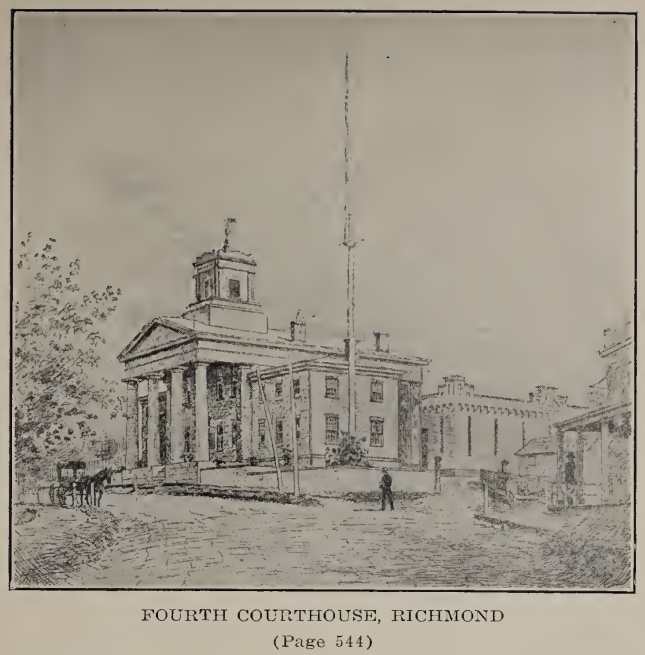
Later court houses in Richmond and St. George mark the shift from makeshift colonial arrangements to civic architecture. The authors describe a sharp 1844 clash between a grand jury and the court over the jury’s independence, proof that institutional authority was contested even in a comparatively small county.
2. Doctors and Medicine
The chapter on medicine starts with the Zieckentroosters, lay visitors of the sick who came over from Holland with Minuit in 1626 and were trained more to give spiritual than physical comfort.
Medicine began with overlapping religious and practical duties. The authors describe Dutch visitors of the sick, ministers, schoolmasters and midwives before formally trained physicians became more common. Care was often local, improvised and shaped by the resources of a small population.
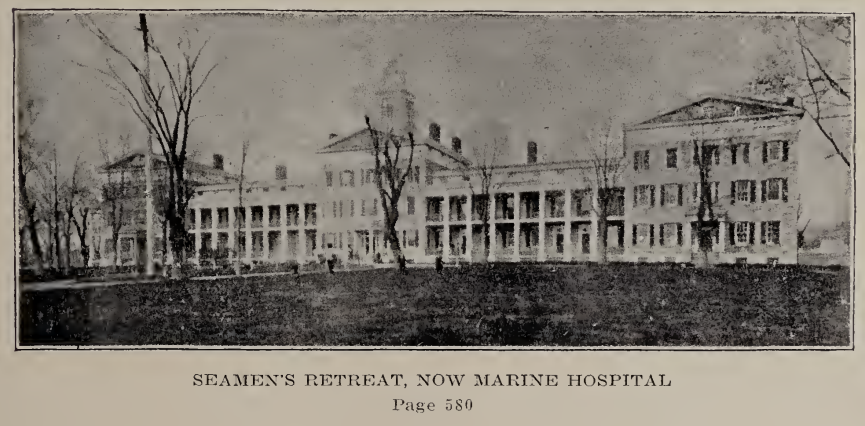
Yellow fever then dominates the story. It reached New York in 1702, and the epidemics of the early nineteenth century peaked in 1822. Staten Island paid a price for hosting the Quarantine, where Dr. Richard Bayley, the officer in charge, “fell a victim to the disease” in 1801. The episode ended with the burning of the Quarantine in 1858.
An interesting item is the account book of Dr. Isaac Fardon, kept from 1822 to 1826. He charged thirty-seven cents for a visit with medicine and three dollars for “puting” wife to bed, though the authors confess the language of the entries is “almost too blunt for quotation.” He often took payment in kind, with entries like “75 oysters, 18 cents” and “7 turkies & Hen, $1.50.” His standard remedy was an emetic, since he seems to have had more faith in “bleeding and phisic” than in medicine. The Moravian Church records show that he died of typhus on March 7, 1827.
As the island developed, medical work became more specialized and institutional. The book traces individual practitioners, hospitals, infirmaries and organized professional activity, showing how care shifted from scattered households toward enduring public facilities.
3. Charity — Organized and Otherwise
Charity followed a similarly uneven path. Early overseers arranged support for poor residents, sometimes paying families to board people in need. The records could be strikingly transactional: an eighteenth-century payment was made for “keping of the Poor,” reducing a complicated human need to a line in the accounts.
By the 1920s Staten Island had a remarkable roster of institutions, and Chapter XVII catalogues them: the Poor House and Farm Colony, Sailors’ Snug Harbor, the Old Ladies’ Home, the Actors’ Home, Catholic, Hebrew, Lutheran, Swedish and Norwegian charities, the Red Cross, and a council to coordinate the whole lot. The authors begin earlier, though, noting that charity “assumed modest proportions in early colonial times.”
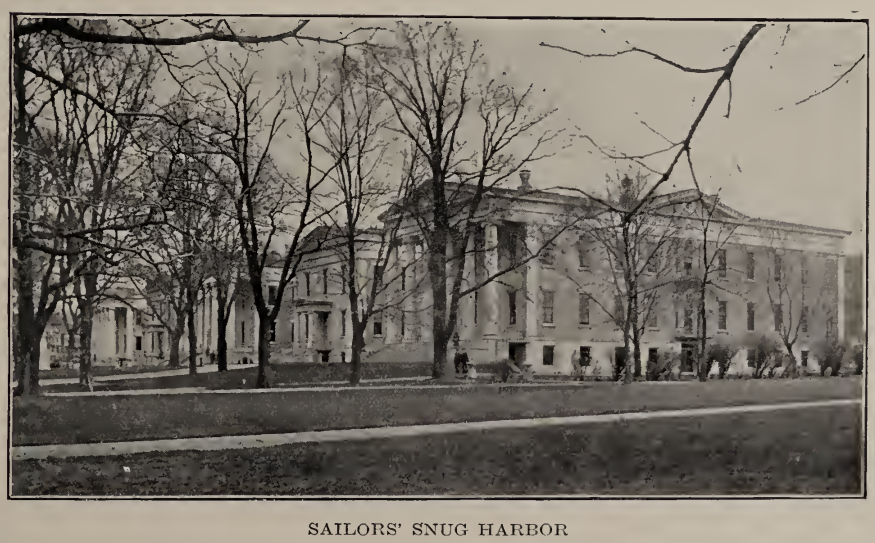
The central figure is a woman: “The first exponent of organized charity on Staten Island was, possibly, Mrs. Josephine Shaw Lowell.” Widowed by the Civil War, she devoted the rest of her life to the poor and tried out her ideas here, including a local effort against beggars the book describes as “reaping a harvest at the hands of a deceived people.” The chapter also records a less flattering episode, in which the mismanagement of the county poor house came to light in the early 1870s after the editor of the Richmond County Standard and the superintendent at Southfield exposed it.
4. Tides, Clay and Oysters to Industry
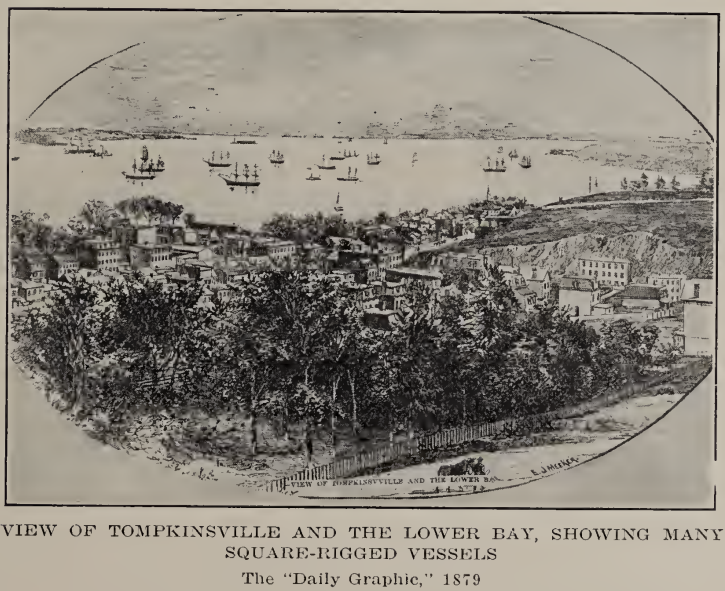
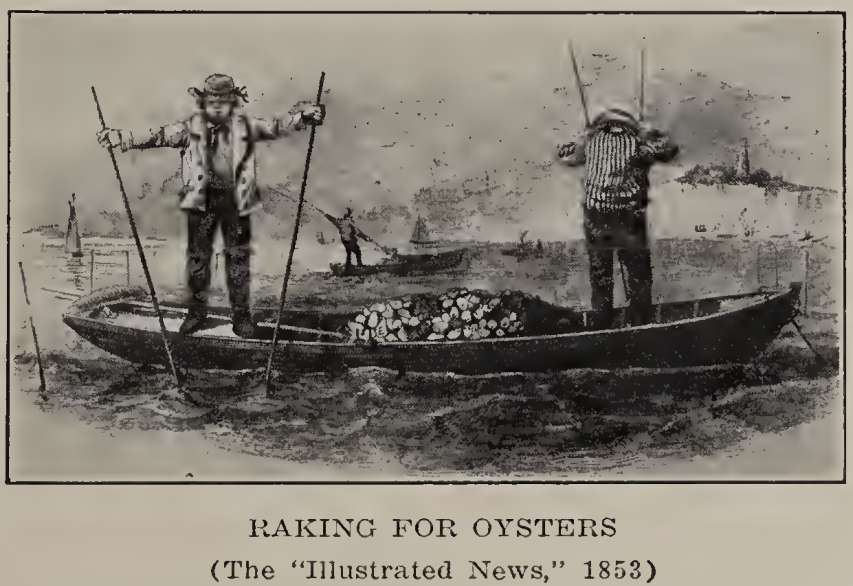
Water explains most of the island’s early industry. The authors note that the many estuaries, such as the Fresh Kill, made so many residents watermen, and that fishing, oystering and shipbuilding followed naturally.
They mention the launch of the “Patty, 264 tons burthen,” from Richard Lawrence’s shipyard before the Revolution, and quote an 1886 guidebook on Tottenville: “More than anything else is Tottenville celebrated for her shipyards and the quality and quantity of work done in them.” On land, the clay beds fed firebrick works. Balthasar Kreischer and Son began making firebrick at Kreischerville in 1854, and the factory burned in 1876 and was rebuilt in 1877.
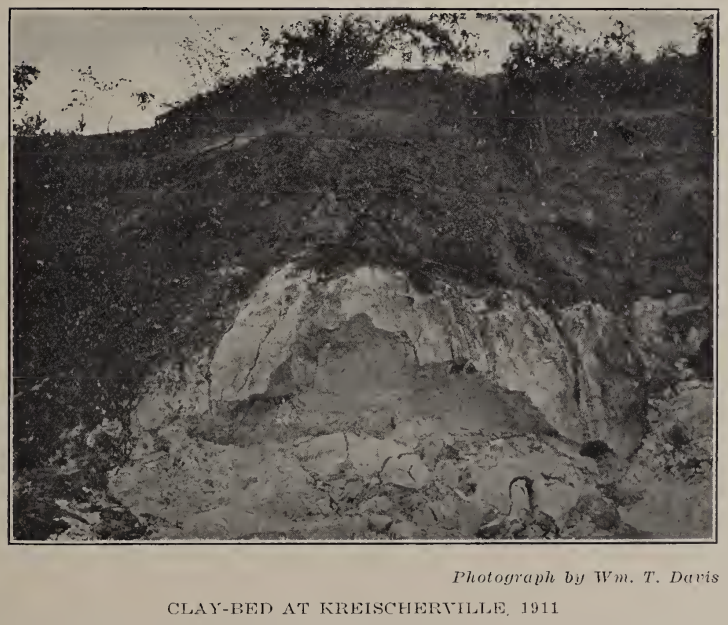
Industry first drew on what the island itself supplied: land, timber, waterpower, clay, stone and access to fisheries. Gristmills, sawmills, tanneries, weaving and blacksmithing served local needs before larger ventures sought customers across the harbor.
The authors are particularly attentive to tidal mills and other ingenious uses of the coastline. The industrial story is therefore not simply one of smokestacks arriving; it begins with the manipulation of creeks, marshes and tides in a working rural landscape.
The shoreline also fed people directly. In February 1842, a farmer wrote, a stretch of northwest wind drove the tide so low that “not less than three hundred people were engaged in digging and raking for this article of food,” each going home with two or more bushels of clams. Davis and Leng add that they have seen “boys pulling toy wagons loaded with a bushel or more” of the same harvest in their own day.
From Mills and Oysters to Modern Factories
Oystering receives considerable attention, alongside shipbuilding, brickmaking, quarrying, chemicals, metalworking and manufacturing. Each industry depended on a different combination of natural resources, transport, capital and labor, and their fortunes rose and fell at different times.
By the book’s closing decades, enterprises such as the soap works at Port Ivory embodied a new industrial scale. The authors call that factory’s story “in some respects the climax of our industrial history,” revealing both their fascination with modern production and their preference for large, visible achievements.
The industrial chapter also preserves traces of hard physical work and the presence of immigrant laborers. That is a useful counterweight to accounts centered only on founders, companies and products: the island was built by workers as well as entrepreneurs.
5. Shops, Money and Shifting Business Centers
Commerce followed population and transportation. Early shops and taverns served agricultural settlements and travelers; later, business clustered near ferry landings, rail stations and growing villages. The island’s commercial map was never fixed.
The authors note that south-shore settlement preceded major growth on the east and north shores. As ferries became more important, landing places attracted inns, stores and services, and business increasingly faced outward toward the wider metropolitan economy.
6. From Wampum to Banking
Chapter XX on banking opens with a line that is hard to forget: “The first medium of exchange on Staten Island was Wampum.” Drawing on a paper read before the Connecticut Historical Society in 1924, the authors explain that the value of wampum varied but was commonly “six white or three black beads to the penny,” and that colonial governments legislated its worth. Massachusetts, for example, made it legal tender for small sums in 1641 and repealed the law in 1661.
The volumes involved were not trivial. One recorded transaction reads “a psell of wampum wch I take at 6 a Penny £29.14.00,” and when Lovelace bought the island from the Indians in 1670, “400 fathoms of wampum” formed part of the payment. The authors find it surprising that so much currency has vanished “except in museums.” The chapter then follows money through Dutch guilders, English pounds, colonial and Continental paper, state and national banks, savings banks and the building loan associations.
7. Ferries, Railroads and the Island’s Lifelines
No subject better unites the volume than transportation. The authors open their transport chapter by observing that Staten Island was “dependent upon its ferries” for people and goods. Water separated it from its neighbors while also offering the routes by which it traded and grew.
The history stretches from irregular crossings by small boats to organized ferry services, steamboats and elaborate terminals. Landing places could become commercial centers; a change in route or service could redirect an entire neighborhood’s prospects.
Periagua ferries (large open sailing boats) preceded steam, and after the Revolution the old routes came back: Butler’s Ferry to Amboy ran from 1788 to 1828, Da Costa’s on the north shore was followed by Ryers’ and later merged into Mersereau’s. In an earlier chapter the authors argue that the east shore owed its commercial lead to the ferry landing, the Quarantine and the turnpike road from the interior, a lead it held until the railroad arrived.
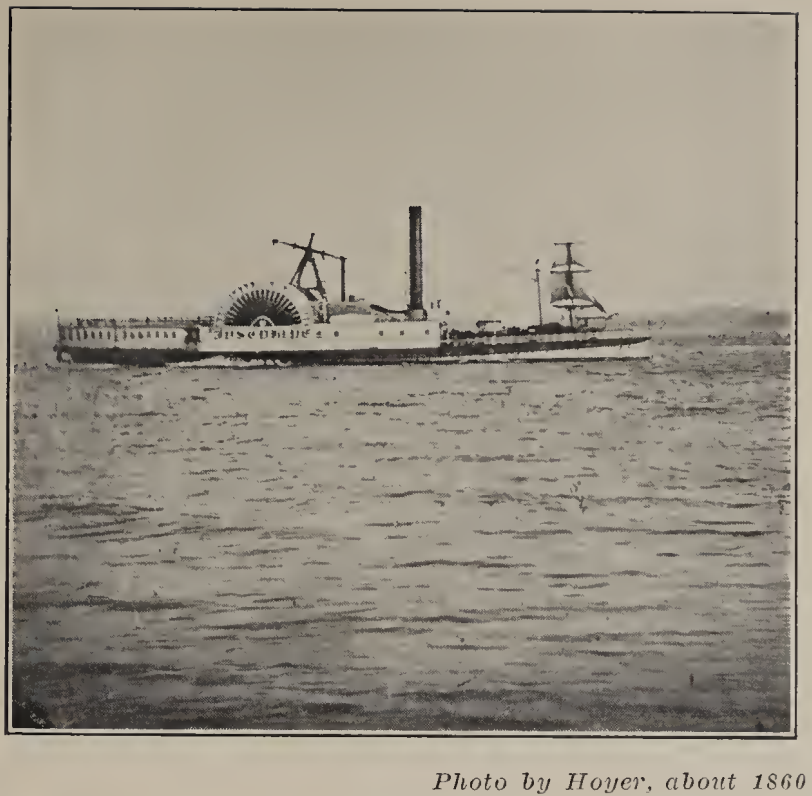
The Civil War shows up in unexpected places. In 1862 the ferryboats Clifton and Westfield were attached to Commodore Porter’s mortar flotilla, and the Gazette reported them “now in the service of the government as gunboats”; the ferry company promptly built replacements. By the twentieth century the ferry was city-owned, with a short employee strike in January 1919 and free transfers to the trolley lines between 1914 and 1919.
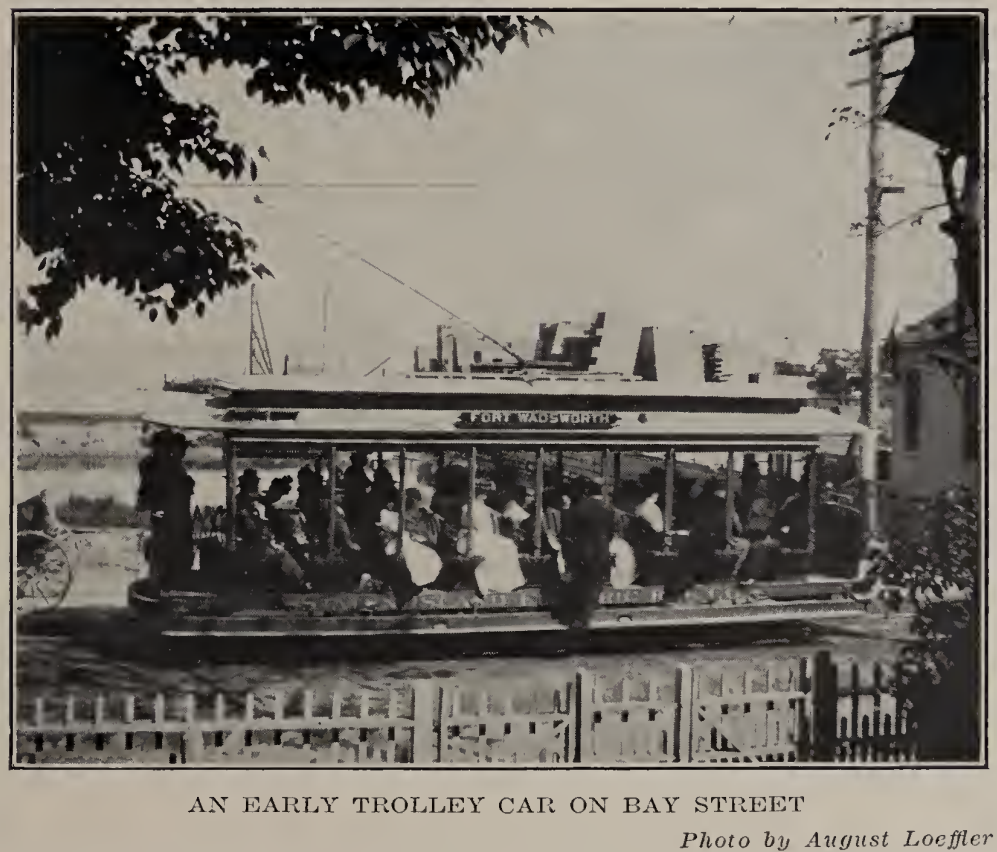
Railroads, horse cars, electric lines, buses and roads brought new forms of movement within the island. The Staten Island Railroad, incorporated in 1836 according to the book, belongs to a larger story of technology repeatedly shrinking travel times and reshaping settlement.
The authors also linger over old paths, bridges, docks, pilotage and public utilities. Their attention to vanished woodland walks is especially evocative: progress brought convenience, but it could erase the quiet routes and rural spaces remembered by older Islanders.
8. Land Ownership and Development
Landownership forms another long thread. The book describes the 1670 purchase negotiated under Governor Lovelace, colonial grants and the difficulty of reconstructing property lines once defined by trees, rocks and streams that later disappeared.
Large estates and old farms were divided, sold and developed. Fine residences, new villages, parks and speculative schemes altered the landscape, while economic downturns interrupted the apparent march toward suburban growth.
The chapter on realty is especially revealing about the late nineteenth and early twentieth centuries, when subdivision and building accelerated. Staten Island’s eventual incorporation into Greater New York in 1898 gave these changes a new governmental setting.
What the authors sometimes describe as improvement also meant loss: of shorelines, old houses, fields and paths. Their own careful recording of vanished landmarks makes the book an inadvertent archive of the costs of development.
9. Candles and the Invention of the Telephone
Some of the book’s most surprising connections run through a candle factory. In 1860 the New York Paraffine Candle Company, with Antonio Meucci as superintendent, occupied a brick building in Stapleton. Giuseppe Garibaldi, banished from Italy, came to the island, where he “became a candlemaker” and lived and worked with Meucci from 1851 to 1853. The house still stood on Tompkins Avenue when the authors wrote this book, protected by what the authors call a “temple-like structure.” It still stands today.
Meucci is also at the center of the book’s telephone story. He is now known to have invented the telephone but when this book was written, Alexander Graham Bell was getting all the credit. The notes that Percival G. Ullman recalled Meucci describing his “talking machine” in 1858. His rights were bought by a telephone company in 1884, so Meucci, who died in 1889, “finally derived some benefit from his invention.”
The same chapter credits Dr. John W. Draper, while living on the island, with discoveries in photography that made Daguerre’s process “suitable for portrait work.”
10. Newspapers, Clubs, and Culture
The first Staten Island newspaper appeared on October 17, 1827; it was named the Richmond Republican. The authors state that a “volume of this first Staten Island newspaper, preserved in the safe of the Staten Island Historical Society, has been of the greatest service to us in preparing this history for its pages present, especially in the advertisements, many details of the doings of a hundred years ago.”
The authors write that “The editor’s interest in politics, horse racing, target firing, fox hunting, Fourth of July celebrations, balls and dinners, seems to reflect a social atmosphere quite different to that of the present time.”
Although the Richmond Republican was written and created on Staten Island — it was printed on Chambers Street in lower Manhattan. The Richmond County Mirror became the first newspaper printed on Staten Island in July 1837 under Francis L. Hagadorn.
The book then details every newspaper Staten Island ever had up until 1927 — 45 in all — providing at least a sentence if not a paragraph on each. See pages 757 to 767 in the book if you are interested in the details. Many of the papers were short-lived, but their advertisements and notices provide intimate evidence of businesses, public meetings, entertainments and everyday concerns.
The authors state that “The “Richmond County Advance” was established at West New Brighton March 27, 1886, by John Crawford, Jr., and became a success. It was later sold to Staten Island Advance Company, S. I. Newhouse, president, and continued under the name of Staten Island Advance.”
Clubs
Associations were another kind of civic infrastructure. Masonic lodges, fraternal orders, clubs and other societies supplied places to meet, celebrate, organize and sometimes quarrel.
The authors write that “The athletic features of 1828, unless we include the Fourth of July
ball on Pavilion Hill, seem to have consisted in fox hunting, horse
racing, and uniformed militia drills.
The Boy Scouts — who to this day have a big camp at the center of Staten Island — were rivaled by the Woodcraft Club.
According to the authors, “the ‘Richmond County Sentinel’ of September 13, 1874, recalls the popularity at that time of the game of croquet.” But the authors point out, “Notwithstanding the competition of all, other forms of athletic sport, baseball remains the principal enjoyment of masculine athletics.”
The authors add, “The women always take great interest in their homes and surroundings and thereby become members of the civic and community clubs previously mentioned.”
There were also numerous Boat, Yacht, and Rowing Clubs. The coverage of clubs and associations is extensive and is covered in pages 769-799 in the book.
The arts and sciences chapter ranges across music, painting, theater, literature, architecture and natural history. The book was written between 1926 and 1929 remember, and so Hollywood movies were still in their silent era. The authors note that “Staten Island has contributed one star to the movies in the person of Mabel Normand. Her father was a stage carpenter and has lived at various times on Sand Street, Tysen Street, and St. Mark’s Place. His daughter after becoming a screen star has made her home in California, but occasionally visits her parents on Staten Island.”
All of the other famous Broadway actors and actresses and other artists from Staten Island mentioned in the book are similarly completely unknown.
Ralph Waldo Emerson
The state that “Ralph Waldo Emerson was a frequent visitor at the home of his brother, William Emerson. The latter lived here from 1837 to 1856, during part of which time he was our county judge. His home here was called “The Snuggery,” a low brown house on Richmond Road which was burned June 20, 1866. We owe the name Concord to the Emersons as a melodious substitute for Dutch Farms; and to Cornelius G. Kolff the happy thought of calling the hill on which they lived, Emerson Hill. Vernon B. Hampton has recorded that Ralph Waldo Emerson’s “Representative Men” was written on Staten Island, as well as many other of his essays.”
Henry Thoreau
The authors also wrote about Henry Thoreau, who spent time on Staten Island. On page 841 they write: “October is the month of painted leaves,” writes Henry D. Thoreau, who so greatly enjoyed tramping over the flaming autumn-tinted hills of Staten Island while an inmate of the Snuggery, the home of William Emerson.”
Putnam Publishing Family
Extensive coverage is given to the Putnam Family — of publishing house fame. “In 1848 G. P. Putnam, founder of the publishing house, now G. P. Putnam’s Sons, together with his family moved to Stapleton where they resided until 1852.” The authors then go on to write about the Putnam’s for 2 pages (pages 810 and 811), including this story: “The Putnam children bathed on the Stapleton beach which was quite near the house and which seems to have been then good and sandy. On one occasion they lost a small pet alligator presented by Mr. Fabens, and it was thought to have made its way to the bay. For a long time the children were in mortal terror lest he might have grown up and so be able to devour them when bathing.”
The authors then go on to list many noteworthy writers and poets who came from or lived or composed works on Staten Island. It’s a fun read — and is on pages 810-828 in the book.
It includes this passage:
“Theodore Winthrop, a charming, cultivated young man, who contributed some worth-while books to American literature, lived before the Civil War with his sister, Mrs. Templeton Johnson, on lower Bement Avenue. His best novel, “Cecil Dreeme,” teams with life-like characterization, bathed in a poetic element of mystery; and “John Brent,” the next in merit, is a graphic sketch of romantic incidents in the Far West, drawn from his own experience. With Robert Gould Shaw he (Theodore Winthrop) was among the first to volunteer and, as a member of the Seventh Regiment, went to his fate at Big Bethel. Of him (Winthrop), Hamilton Willcox wrote in Bayles’ History (p. 635) “explorer, novelist and orator, whose country saw him last by the flashes of musketry against the black night of a Virginia forest, standing on a gun, striving to rally the Union troops whom surprise had confused and disordered, and who, while going to his death, wrote to a companion of his country walks, ‘Ah me! in these sweet balmy May days I miss my Staten Island.’ ”
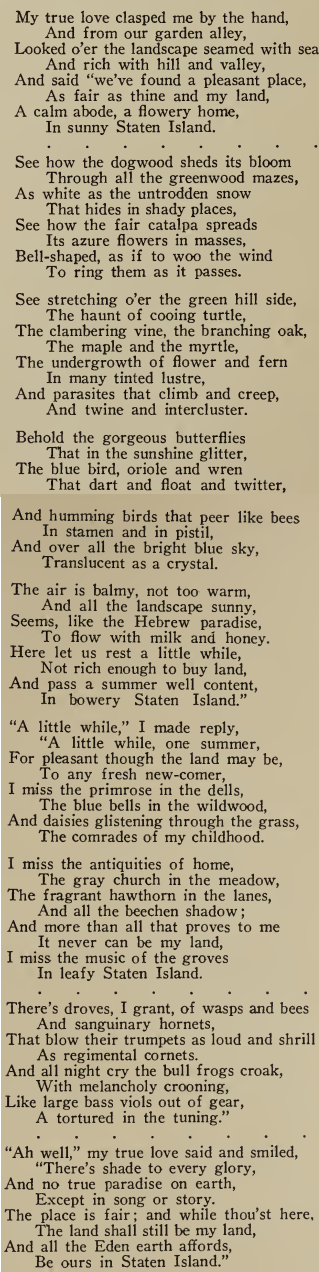
And then on page 812 there’s this crazy poem by English poet and Staten Island resident Charles Mackay:
The book then covers all the scientists and engineers who have lived on the island. As we’ve written above, it is an exhaustive book.
Tales
Then come tales of Staten Island — like the tale of The Mysterious Cattle Slayer. “Tradition says that thirty or thirty-five years before the War of the Revolution began—that is to say, if the Declaration of Independence is assumed to be the beginning of that war—between 1741 and 1746, the agricultural community of Staten Island, which then probably embraced nine-tenths of the population, became terribly excited by the frequent and mysterious killing of their cattle. They were found dead in their pastures with their throats cut, in every instance close to their heads. At first it was ascribed to some enemy of the owner, who adopted this method of gratifying his vindictive inclinations, but it was at length discovered that in every case the animal’s tongue had been cut out and taken away. ” It’s a long tale that is told on page 839. Other tales, such as The Buried Guineas (the money), follow.
11. Families, Houses, Graves & the Future
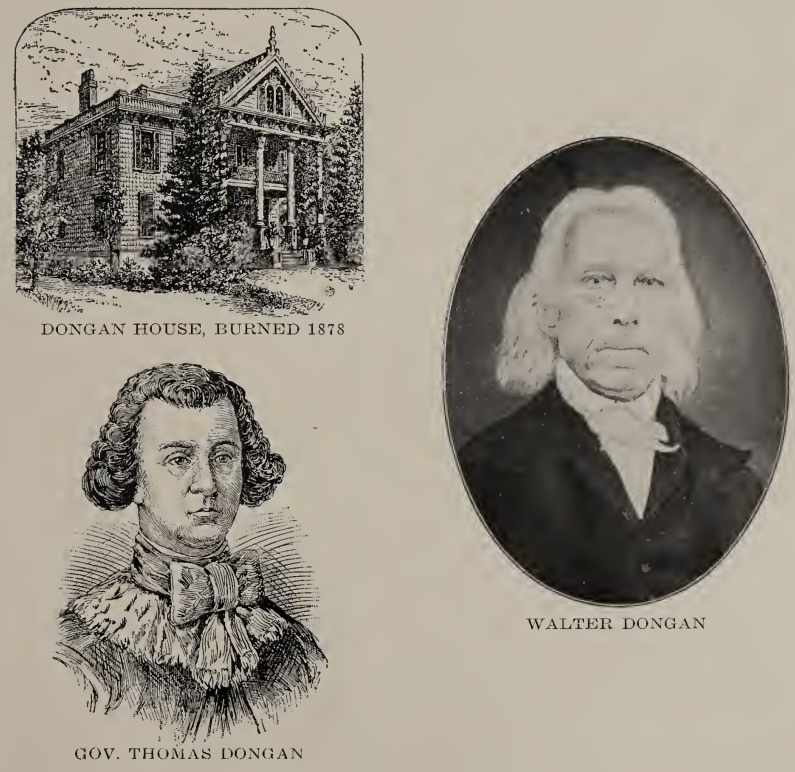
Chapter XXVI, the book’s longest, is an enormous chapter on old families and homes. The book arranges the island’s old families alphabetically and treats their houses, cemeteries and gravestones as evidence. The authors date the roots of the oldest surviving family histories to the settlement of 1661, then follow generations of households through migration, marriage, property and changing communities.
Its genealogical detail can feel overwhelming, but it also demonstrates that the history of a place is made through relationships as well as public events. Names appearing in the courts, on maps and in businesses recur in family histories, tying the volume’s subjects together
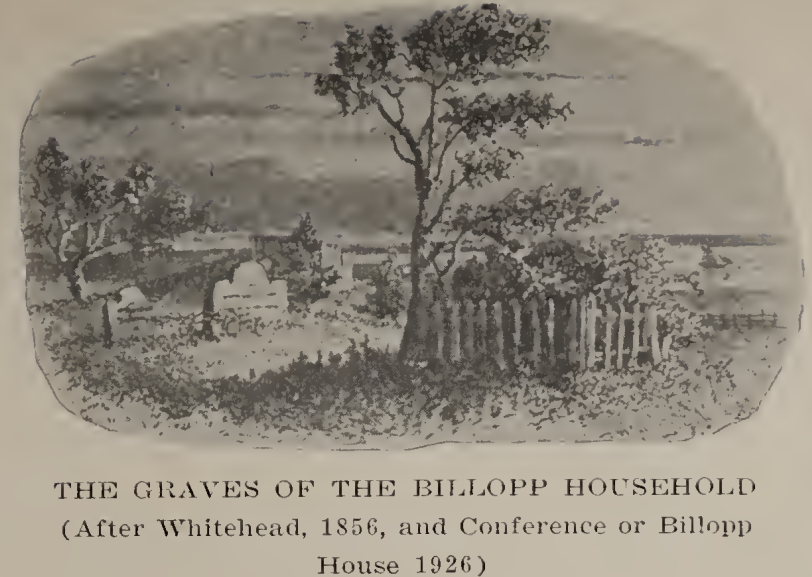
The details can also be wonderful. John M. Butler’s stone in Bethel Cemetery, Richmond Valley, gives his dates as January 16, 1810, to April 10, 1913. Neighbors remembered “Uncle” John Butler racing a horse against Mr. Bogardus on the Amboy Road, and Butler, though very old himself, “beat Bogardus, who was also quite old.”
The miscellany includes a note book kept by James Guyon recording the births of slaves’ children between 1817 and 1833, “a period when their age had a bearing on their freedom,” and a tax calculation for 1766 that works out to “a little less than one dollar per capita.”
The last substantive item looks forward. Quoting a 1929 newspaper report, the authors describe the Regional Plan Committee’s proposals “looking forward to the year 1965,” when railroad traffic into New York terminals was expected to reach 270,000,000 passengers a year, with a trunk line system that would include Staten Island and a union passenger station south of Port Richmond. Readers who know that the Verrazzano-Narrows Bridge opened in 1964 can enjoy how confidently the planners forecast the future, and how carefully the book itself preserves a past that might otherwise have been lost.
The Book Itself — Available Here
Click the link to read Volume II of the book itself:
Be the first to comment